
Why Are Langley’s New Housing Rules Changing Neighborhoods?
Langley is entering a new phase of residential growth. Rules introduced through provincial housing legislation now allow more homes on many lots that once held single-family homes or duplexes.
The township adopted zoning changes in November 2024 to support small-scale multi-unit housing in Langley. Eligible properties can now support three or four units, depending on the lot size and other conditions.
For homeowners considering how these rules may affect their property, understanding the difference between a secondary suite, accessory dwelling unit, and multiple-unit property is important. Bowline Construction explains the value of getting multi-unit housing done right the first time when planning for changing housing needs.
What Does Gentle Density Mean for Existing Streets?
Gentle density means adding homes at a scale that can fit within established residential areas. The Township of Langley describes small-scale housing as:
- Secondary suites
- Detached garden suites
- Duplexes
- Three- or four-unit homes
The result of gentle density can be a gradual shift in the makeup of a neighborhood. An area that once had few households per block may eventually have several households or even duplexes on the same lot, making the neighborhood more dense. This also creates more housing opportunities.
However, adding more housing units can also impact other elements of a neighborhood. It can change the demand for parking, access to outdoor spaces, transit needs, schools, and other neighborhood resources.
What Do the New Rules Mean for Langley Homeowners?
The most important change that Langley homeowners should understand is that certain residential lots may now have multiple small-scale housing units. This means that, for some homeowners, you may be seeing new developments arise next to your home.
For eligible lots, the Township of Langley permits three units on lots up to 280 square metres and four units on lots between 280 square metres and 4,050 square metres, or one acre. Properties over one acre are not eligible for SSMUH under these rules.
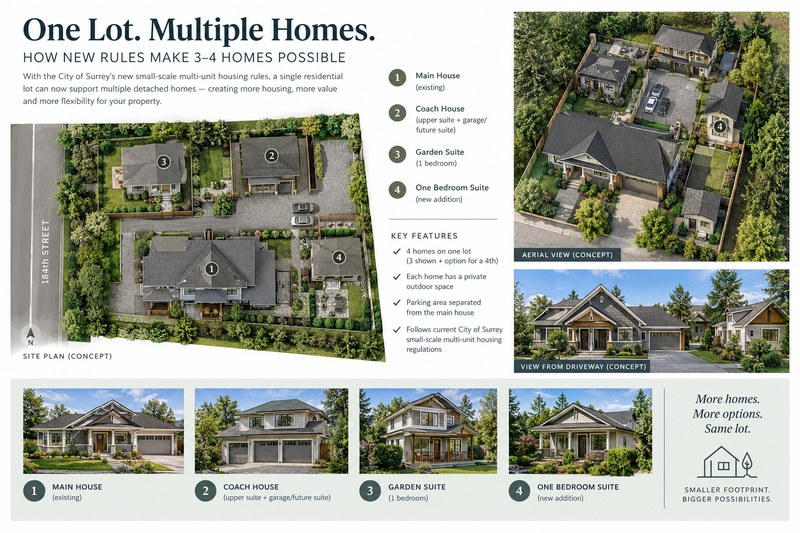
However, zoning alone does not determine what is possible. A property must meet several requirements, and site-specific conditions can change the outcome.
This makes property research more important than simply counting units.
Homeowners should start by checking:
- The property’s current zoning and lot size.
- Whether municipal water and sewer service are available.
- Whether the property is inside the Urban Containment Boundary.
- Whether heritage or other restrictions apply.
- Whether the property is within a Transit Oriented Area.
- Whether local development permit rules affect the property.
How Could These Rules Affect Property Value?
The new rules may change how buyers in Langley view certain residential lots. A property with potential for several homes can have a different market appeal from a property that can support only one household.
However, that does not mean every eligible property will automatically increase in value. Market demand, land costs, servicing, approvals, location, and the cost of meeting current rules all impact how a piece of property is viewed by potential buyers.
The key shift is that development potential is becoming part of the property conversation. For buyers, that means asking more than whether a home is attractive today. It may also be worth asking what the lot could support under current zoning in the future.
How Will More Housing Change Langley’s Neighborhood Character?
Adding homes to a neighborhood can change it without transforming its identity.
Langley has already been planning for major population growth. In fact, the township projects that its population could nearly double to 211,000 by 2041. This would then create demand for more than 34,000 additional housing units.
Small-scale housing is one way to spread that growth and increase housing choices across existing communities. It can support more housing options for families, renters, seniors, and multigenerational households, while also helping people stay in familiar neighborhoods when their needs change.
Adding housing to a neighborhood can even help elevate its character. More households often result in more people:
- Patronizing local businesses
- Relying on public transit
- Walking local streets and utilizing public resources like parks
- Participating in community life
Our team has also explored this issue in its guide to multi-generational housing and ADUs in Langley, which shows how changing housing types can help support families through different stages of life.
Will Every Langley Street Look Different?
No. The rules do not require every property to add more units.
Single-family homes are still permitted in the affected residential zones and can continue to reside on one lot alone if the owner sees fit.
Instead, these rules create more choices for property owners and increase housing capacity across eligible areas. Change will likely happen lot by lot rather than all at once.
Langley has also introduced form and character guidelines for small-scale multi-unit housing through its Official Community Plan. This requires developers to review how new housing fits into the surrounding streetscape and ensures each new building meets specific character requirements.
What Should Homeowners Look for as Langley’s Neighborhoods Evolve?
Rules, servicing, planning requirements, and neighborhood conditions all matter. The Township of Langley advises property owners to confirm eligibility for small-scale housing because site-specific conditions can impact what type of properties are allowed in certain areas.
Infrastructure is another important issue. Water, sanitary systems, drainage, roads, and other services must support new housing, and some areas may have specific servicing limits or requirements.
For homeowners, the practical takeaway is simple: Always check a lot’s eligibility. Even if a lot has a single-family home now, new developments may arise quickly if it has the space.
Before searching for a new home or looking for property to add onto, it’s important to identify your goals and what you’re looking for. Multi-generational families looking to live close together in duplexes may have different needs than two newlyweds searching for an apartment.
What Does This Mean for Langley’s Future?
The new housing rules are part of a larger shift in how communities across British Columbia plan for growth.
For Langley, the change is especially important because population growth is creating pressure for more homes while residents still want livable, connected neighborhoods.
Small-scale multi-unit housing in Langley can help bridge that gap. It adds housing capacity while keeping many new homes at a smaller, neighborhood-scale form.
The effects will not be identical everywhere. Some areas will see more change than others, and infrastructure, market demand, and local planning will shape how quickly new housing appears.
For homeowners and buyers, the best response to these changes is to stay informed. Understanding the rules today can make it easier to make smart decisions as Langley continues to grow.
FAQs About Langley’s New Housing Rules
How Many Units Can an Eligible Langley Lot Have?
Eligible properties can generally have three or four units, depending on lot size. Lots up to 280 square metres can have three units, while eligible lots between 280 and 4,050 square metres can have four units. Other requirements also apply, including servicing and location rules, so homeowners should confirm eligibility for a specific property with the Township of Langley.
Will Small-Scale Housing Be Added to Every Property?
No. Whether or not a lot will have more units developed on it depends on several factors. The township assigns certain requirements, such as zoning conditions, lot size, and more. Additionally, properties in transit-oriented areas are subject to different rules. Because requirements can vary by site, property owners should confirm their property’s eligibility for small-scale housing additions.
Are Single-Family Homes Still Allowed?
Yes. The new rules do not require homeowners to add more units. The township confirms that single-family homes can still be built in affected residential zones. The major change is that eligible properties may now have more housing options available. This gives homeowners greater flexibility while allowing Langley to increase housing supply within existing residential communities.
Why Does This Matter for Existing Neighborhoods?
More units can bring more households into established areas without relying only on large apartment buildings or new subdivisions. That may increase housing choice and support multigenerational living, renters, and smaller households. At the same time, neighborhoods may experience changes in parking, traffic, privacy, and streetscape. The long-term effect will depend on where and how new housing is added.
Ready to Explore What Langley’s Housing Changes Mean for You?
As Langley’s housing rules evolve, understanding what kind of property you live on and its eligibility for small-scale multi-housing units is crucial.
At Bowline Construction, we help residents of Langley achieve their goals through our exceptional building experience, extensive knowledge, and high-quality construction and renovation services.
Connect with the team at Bowline Construction to learn more about the possibilities ahead. Contact us today.