
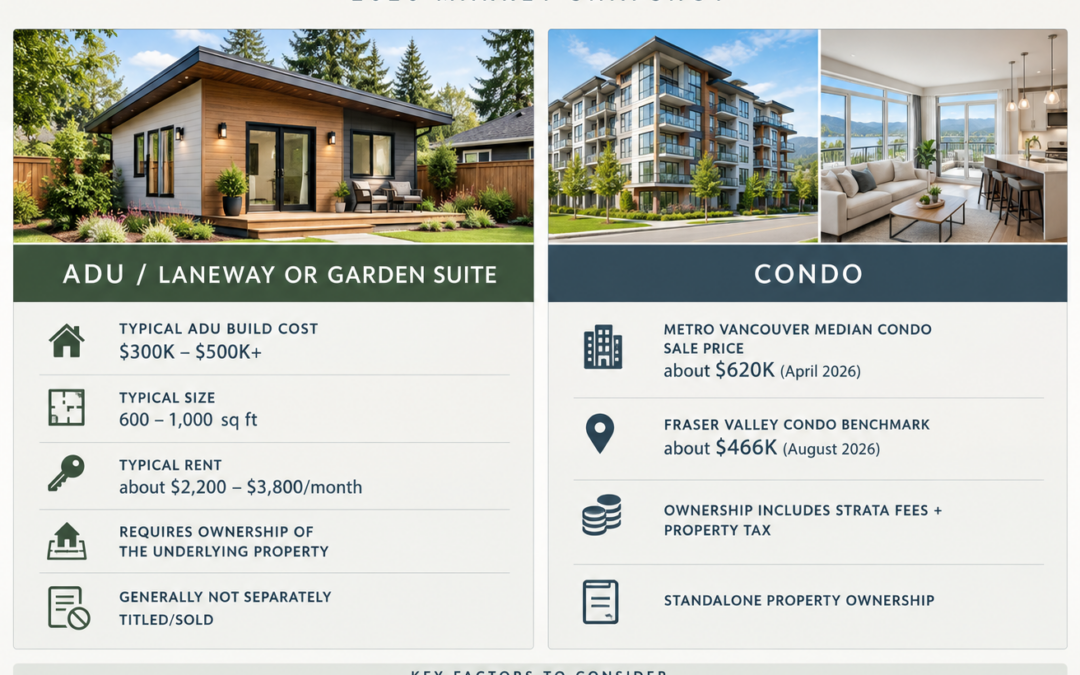
Does $500,000 Buy More With an ADU vs. Condo?
A $500,000 budget may provide more space, privacy, and control when used to build an ADU on suitable family land. A condo may offer a faster move and a simpler buying process. The better choice depends on construction costs, location, property limits, monthly fees, and your family’s long-term plans.
Why Are BC Families Asking ADU vs. Condo?
A condo may seem like the clearest choice for an adult child or aging parent, but rising housing costs and new housing rules are changing that. More families are asking what they could build on land they already own. BC has expanded small-scale housing options, including detached ADUs, garden suites, and laneway homes. Local zoning, servicing, setbacks, and site conditions still decide what can be built on each lot.
Bowline Construction has seen families explore ADUs as a way to stay close without sharing one home. The question is now, “What could the same budget create on family land?”
ADU vs. Condo at a Glance
This comparison is not a fixed quote. Actual costs depend on the property, design, location, and housing market.
| What to Compare | $500,000 ADU Budget | $500,000 Condo Budget |
|---|---|---|
| Space | Custom build layout | Buy available unit |
| Land | Built on family land | Shared common property |
| Design | Tailored to household needs | Standardized condo design |
| Monthly costs | No strata fee | Monthly strata fees |
| Outdoor space | Potential for private yard | Limited or shared outdoor space |
| Timeline | Depends on construction | Immediate move‑in after purchase |
| Future use | Flexibility (rental, family) | Limited by condo rules |
How Much Living Space Could $500,000 Provide?
A condo buyer must choose from the units available at that price. The home may have fewer bedrooms, less storage, and little private outdoor space.
An ADU can be designed around the people who will live in it. A family may choose more bedrooms, wider doors, extra storage, or a private entrance if the property and budget allow it.
Bowline recently proposed an ADU for a family with four generations on one property. The younger household had originally been thinking about purchasing a small condo but decided to go with a 1,200-square-foot home on family land.
What Do You Own After Spending the Money?
A condo buyer owns a private unit and shares responsibility for common property. Roofs, hallways, elevators, landscaping, and other areas are managed through the strata.
An ADU becomes part of the property where the main home stands. The family does not buy a second piece of land and keeps control of the full property.
Families should get legal and financial advice before building on shared family land. Ownership, financing, taxes, estate plans, and family agreements should be clear.
How Much Can You Customize Each Home?
A condo normally has a finished layout. Floors, paint, and cabinets may be changed, but walls, entrances, windows, and plumbing can be harder to move.
An ADU can be designed for a parent, adult child, young family, or person with mobility needs. Separate entrances, fewer stairs, sound control, and private outdoor areas can support independence.
What Will You Pay After Moving In?
Condo owners usually pay monthly strata fees for shared insurance, maintenance, services, and reserve funds. Fees may rise, and owners can face special assessments for major repairs.
An ADU has no separate strata fee, but it still has ongoing costs. The owner must budget for utilities, insurance, taxes, repairs, financing, and upkeep.
Which Option May Offer Better Long-Term Value?
Choosing between an ADU vs. condo can be a major decision. Both options may gain value, but appreciation is never guaranteed. The market, location, building condition, project quality, and property features all matter.
An ADU may add living space and several future uses to one property. It could house a parent now, an adult child later, or a tenant if local rules allow it.
A condo may also gain value. Its costs and value are partly tied to the condition and management of the full strata property.
Which Option Gets Your Family Housed Faster?
A condo is usually faster. After financing, inspections, and closing, the home may be ready for the buyer.
An ADU requires a site review, design work, permits, preparation, and construction. That timeline may be worthwhile for a custom home, but a condo may be better when housing is needed quickly.
How Could Each Choice Change Family Life?
An ADU can make daily support easier while protecting privacy. Grandparents may help with childcare, adult children may help aging parents, and each household can still have its own home.
One South Langley homeowner with five acres wants housing for an elderly mother, a daughter who travels, and other relatives. The goal is to keep several generations close while protecting independence.
A Surrey homeowner is also exploring adding homes to her land for her adult daughters and grandchildren. Her plan shows how the changing zoning can help families solve problems, not just add investment opportunities.
When Does a Condo Make More Sense?
A condo may be better when the buyer needs to move soon, wants a certain location, or has no suitable family land. It may also suit someone who prefers shared exterior maintenance and does not want to manage construction.
An ADU is not always the better value. Difficult access, utility work, drainage, permits, site preparation, and custom finishes can reduce how far the budget goes.
FAQs About ADUs and Condos
Is It Cheaper to Build an ADU or Buy a Condo?
It depends on the land, site, home size, design, permits, utility work, and local condo market. A family that already owns suitable land may avoid buying another property, but an ADU can still require costly site work. Compare full project estimates, closing costs, strata fees, maintenance, and financing before deciding.
Can I Build an ADU on My Property in BC?
BC’s small-scale multi-unit housing rules have expanded the types of housing allowed in many residential areas, including detached ADUs in certain locations. However, every property is different. Local zoning, lot size, setbacks, access, utilities, environmental limits, and building rules must be reviewed before design or construction begins.
Do ADUs Have Monthly Strata Fees?
A detached ADU on family-owned property usually does not have its own monthly strata fee. The owner must still pay for utilities, insurance, taxes, repairs, maintenance, and financing. A condo fee may cover some shared services and building work, so compare what each option includes rather than only the monthly totals.
Find Out What $500,000 Could Do on Your Property
The same $500,000 can lead to two very different homes. A condo may offer speed and a set location, while an ADU may provide more space, privacy, control, and room for family life.
The team at Bowline Construction can help you explore what may be possible before a major financial decision. A feasibility consultation can show whether building on land you or your family already owns deserves a closer look. Contact us today to learn more about our services.